


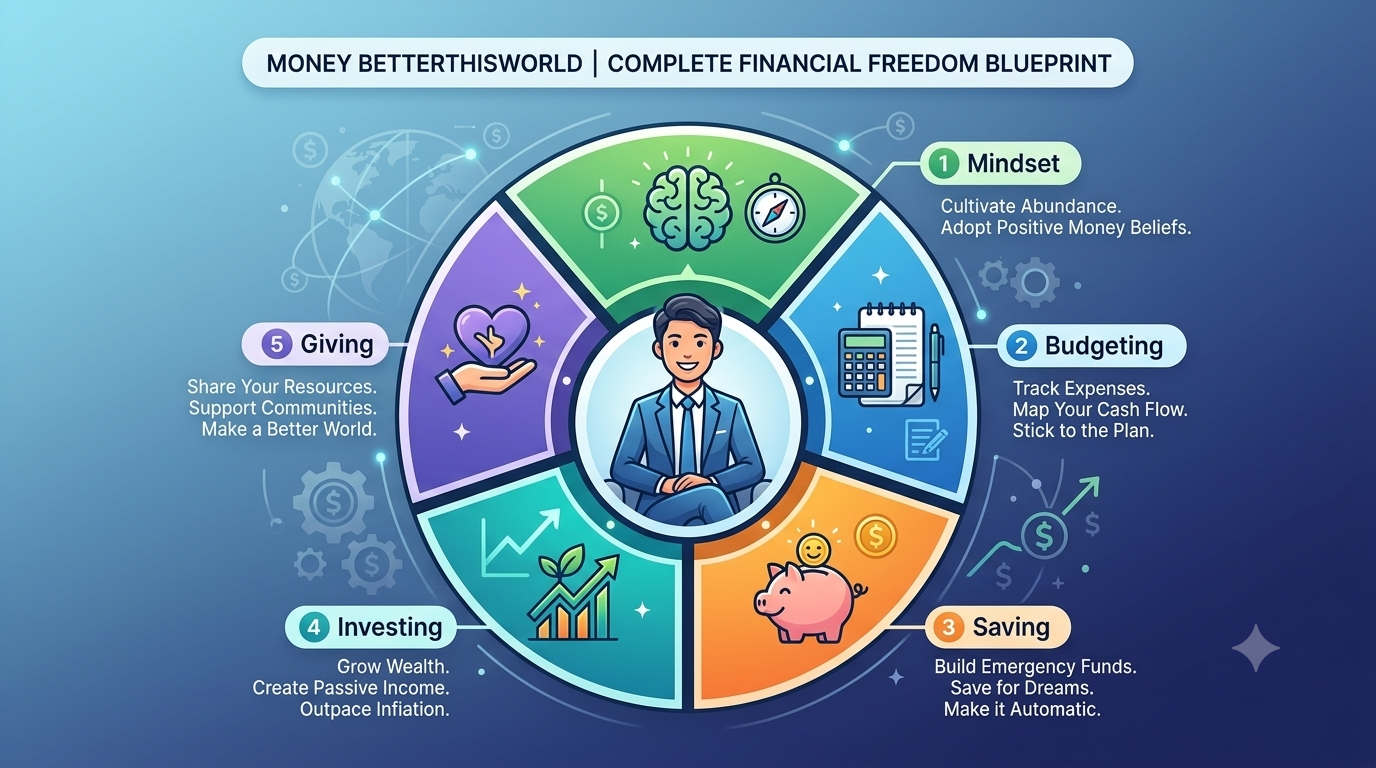
The Ultimate Blueprint for Financial Freedom, Purposeful Wealth, and Legacy Building
Introduction: Beyond Money Management—A Philosophy for Life
Money is not the goal. The goal is a life of freedom, security, and purpose. Money is simply the vehicle that helps you get there. Yet, most people never learn to drive this vehicle with skill and intention. They either let money control them, or they avoid it altogether, leading to stress, missed opportunities, and unfulfilled potential.
BetterThisWorld Money 2026 is not just another personal finance system. It is a comprehensive life philosophy that integrates smart financial habits with deep personal values. It challenges you to move beyond the daily grind of paying bills and instead view your finances as a powerful tool for creating the life you truly want—for yourself, your family, and your community.
This guide is designed to be your definitive roadmap. We go far beyond the basics, offering a 20x deeper, more actionable, and more insightful exploration of how to achieve true financial well-being. We will dissect the core principles, provide step-by-step strategies, and introduce concepts that other articles miss, ensuring you have everything you need to not just manage money, but to master it and build a lasting legacy.
1. The Money BetterThisWorld Mindset: Redefining Your Relationship with Wealth
Most financial problems are not about math; they are about mindset. The Money BetterThisWorld philosophy begins with a fundamental re-evaluation of what money means to you. It moves you from a state of scarcity and fear to one of abundance and purpose.
1.1. Money as a Tool, Not a Master
The cornerstone of this philosophy is viewing money as a servant, not a master. It is a means to an end, not the end itself.
-
The Old Mindset: “I need more money to be happy/secure/valued.” Money is the prize.
-
The BetterThisWorld Mindset: “I have goals and values. Money is the resource that will help me achieve them.” Money is the fuel.
This subtle shift changes everything. It reframes financial decisions from a place of lack (“I can’t afford this”) to a place of empowerment (“This doesn’t align with my priorities right now”).
1.2. Identifying and Overcoming Limiting Beliefs
We all carry “money scripts”—deeply held, often unconscious beliefs about money passed down from our families, culture, and past experiences. These scripts can be self-sabotaging.
Common Limiting Beliefs:
-
“I’m not good with money.”
-
“Rich people are greedy/unethical.”
-
“You have to work hard and suffer to earn money.”
-
“I’ll never be wealthy, so why bother?”
-
“It’s selfish to want more money.”
The BetterThisWorld Method to Break Them:
-
Acknowledge and Name: Write down a limiting belief that holds you back.
-
Challenge It: Ask yourself: “Is this absolutely true? Is it true for everyone? Where did I learn this?”
-
Replace It: Create a new, empowering belief. “I am learning to be better with money every day.” “I can build wealth in a way that aligns with my ethics.” “Earning more money allows me to have a greater positive impact.”
1.3. Embracing the Power of “Slow and Steady”
Our culture is obsessed with quick fixes and instant results, but lasting financial security is built through consistent habits over time.
-
The Problem with Get-Rich-Quick: It often involves taking on immense risk, leads to burnout, and rarely creates sustainable wealth. It’s based on luck, not a system.
-
The BetterThisWorld Way: We champion steady, compounding progress. Small, consistent actions—like saving $50 a week, investing in an index fund monthly, or consistently applying for better roles—accumulate into remarkable results over years.

2. The Ultimate Budgeting Framework: Beyond “Tracking Expenses”
A budget is not a cage; it’s a map. It shows you where your money is going and empowers you to direct it toward what truly matters. The Money BetterThisWorld approach goes beyond simple tracking to intentional allocation.
2.1. Three Budgeting Models to Suit Every Personality
One size does not fit all. We provide three distinct, proven models so you can choose what fits your lifestyle and psychological needs.
| Budgeting Model | How It Works | Best For | Why It’s Better |
|---|---|---|---|
| 50/30/20 Rule | 50% Needs, 30% Wants, 20% Savings & Debt. | Beginners and those who want simplicity. | Easy to grasp and implement; provides a clear, balanced framework. |
| 70/10/10/10 Rule | 70% Living Expenses, 10% Savings, 10% Investments, 10% Giving/Debt Paydown. | Those with some flexibility who want to prioritize investing and giving. | Encourages proactive wealth-building and generosity from the start. |
| Pay Yourself First | Automate savings and investment contributions the moment you get paid. The rest is for living expenses. | Anyone who struggles with saving or spending impulsively. | Uses automation to remove reliance on willpower, guaranteeing you prioritize your future self. |
Implementation Guide:
-
Calculate Your Take-Home Pay: Start with your net income after taxes and deductions.
-
Define Your Categories: What counts as a “Need” vs. a “Want”? Be honest. Rent is a need. Netflix is a want (even if you love it).
-
Allocate and Automate: Set up automatic transfers for savings and investments to a separate account. Pay bills as they come.
-
Track and Tweak: Review your budget weekly or monthly. Identify leaks (like subscriptions you forgot about) and make adjustments. This is a living document, not a set of stone tablets.
2.2. The Proactive “Zero-Based Budget” (For Advanced Planners)
For those who want total control, the zero-based budget ensures every dollar has a job. Your goal is to plan your income down to zero—not by spending it all, but by assigning every dollar to expenses, savings, investments, or debt repayment.
How it works:
-
Start with your income for the month.
-
List all your expenses, savings goals, and debt payments.
-
Allocate your income to these categories until your total equals zero.
-
This forces you to be incredibly intentional and is the most powerful way to find extra money to accelerate your goals.
2.3. Smart Spending: The 72-Hour Rule and Value Alignment
Conscious spending is a key pillar of this philosophy.
-
The 72-Hour Rule: When you feel an impulse to buy a non-essential item, add it to a list and wait 72 hours. This pause eliminates emotional spending. Most of the time, the urge will pass.
-
The Value Test: Before any major purchase, ask yourself: “Does this purchase truly add value to my life?” “Does it align with my stated priorities and goals?” Spending on a hobby that brings you joy is value. An expensive status symbol that doesn’t fulfill you is a drain.
3. Master Your Savings: Building a Financial Fortress
Saving without a purpose is pointless. The Money BetterThisWorld method gives every savings account a clear mission.
3.1. The Tiered Savings Strategy
Instead of one big lump sum, we recommend a multi-tiered approach for different life stages and goals.
| Savings Tier | Purpose | Target Amount | Where to Keep It |
|---|---|---|---|
| Tier 1: Emergency Fund | For unexpected job loss, medical bills, car repairs. | Starter: $1,000 Full: 3-6 months of essential expenses. |
High-yield savings account (HYSA) for easy, penalty-free access. |
| Tier 2: Short-Term Goals | Down payment for a house, a car, a dream vacation, a course to boost your career. | Set a specific number based on the goal’s timeline and cost. | HYSA for goals within 3-5 years. |
| Tier 3: Long-Term Goals & Retirement | Tax-advantaged retirement accounts. | Maximize employer match, then maximize annual IRA/401(k) contributions. | Investment accounts (Brokerage, 401(k), IRA). |
Action: Open two different savings accounts. Name them “Emergency Fund” and “Dream Goal.” The psychological effect of seeing the name on a dedicated account is powerful.
3.2. Automated Savings: The “Set It and Forget It” Method
You can’t spend what you don’t see. This is the single most effective wealth-building habit.
-
Calculate a realistic savings amount based on your budget (e.g., 10-20% of your income).
-
Set up an automatic transfer from your checking account to your savings/investment accounts on payday.
-
Increase the amount annually or whenever you get a raise.
4. Smart Debt Management: From Burden to Stepping Stone
Debt is a tool. Used wisely, it can build wealth (mortgage, student loans). Used poorly, it can crush you (high-interest credit cards). The Money BetterThisWorld philosophy empowers you to wield this tool, not be crushed by it.
4.1. The “Attack and Eradicate” Plan
-
List Everything: Write down all your debts, their balances, interest rates, and minimum payments.
-
Prioritize: High-interest credit card debt is an emergency. It’s a cancer on your wealth. This must be your #1 priority. Student loans and mortgages are lower priority due to potentially lower rates and tax advantages.
-
Choose Your Method:
-
Debt Snowball: Pay off the smallest balance first to build momentum and motivation. Great for psychological wins.
-
Debt Avalanche: Pay off the highest interest rate first to save the most money over time. Mathematically superior.
-
-
Use the “Extra” Money: Every time you get a raise, a tax refund, or any unexpected money, direct a portion of it to accelerate your debt payoff.
4.2. Avoiding the Debt Trap
-
Stop the Bleeding: Cut up the credit cards or freeze them in a block of ice if you can’t trust yourself. Stop using them for daily purchases.
-
Consolidate with Caution: Consolidating debt can be beneficial if it lowers your interest rate. However, never do this unless you’ve addressed the spending habits that got you into debt in the first place, or you’ll just run up the cards again.
-
Build a Mini-Emergency Fund: Keep $500-$1,000 in savings while paying off debt. This prevents you from turning to credit cards when a minor emergency hits.
5. Investing with Purpose: The BetterThisWorld Way
Investing is how you put your money to work to build long-term wealth. The BetterThisWorld approach is about doing it smartly, ethically, and with a long-term view.
5.1. The “No-Nonsense” Investment Starter Kit
You don’t need to be a Wall Street expert. You need a simple, proven system.
-
The 401(k) Match: If your employer offers a match, contribute enough to get the full match. This is a 100% return on investment (ROI). It’s free money.
-
The Roth IRA: After getting the match, open a Roth IRA. It’s a tax-advantaged account where your money grows tax-free forever.
-
Invest in Broad Index Funds: Don’t try to pick individual winning stocks. Buy the whole market. An S&P 500 index fund or a Total Stock Market Index Fund provides instant diversification at a very low cost. This is the strategy recommended by Warren Buffett for most investors.
5.2. Introducing BetterThisWorld Stocks: Ethical Investing (ESG)
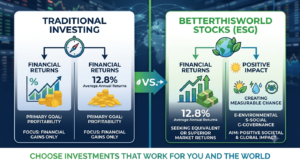
This is a concept the competitor article touches on lightly. We will deeply explore it. “BetterThisWorld Stocks” refers to investing in companies that align with your values—a practice known as ESG (Environmental, Social, Governance) investing.
-
What it means:
-
Environmental: Companies focusing on renewable energy, sustainability, and reducing carbon footprints.
-
Social: Companies that promote diversity, fair labor practices, and community engagement.
-
Governance: Companies with transparent, ethical leadership and fair executive pay.
-
-
Why it’s not just “feel-good” investing:
-
Companies with strong ESG practices often have better long-term risk management and can be more resilient to regulatory changes and consumer shifts.
-
Studies have shown that ESG funds often perform as well as, or better than, traditional indexes over time.
-
-
How to Get Started: Look for mutual funds and ETFs that have a strong ESG rating. Popular options include Vanguard ESG U.S. Stock ETF (ESGV) or iShares MSCI KLD 400 Social ETF (DSI).
5.3. Mastering the Market: You Don’t Have to Be Right, Just Consistent
-
Dollar-Cost Averaging (DCA): This is the practice of investing a fixed amount of money at regular intervals, regardless of the market’s ups and downs. When prices are low, you buy more shares. When they are high, you buy fewer. This smooths out volatility and removes the dangerous “guesswork” of timing the market.
-
Market Volatility is Your Friend: If you are a long-term investor (10+ years), market crashes are not a reason to panic. They are a “sale” on stocks. Stay the course and continue your regular investments.
6. Supercharge Your Income: Creating Multiple Streams
Sometimes, cutting expenses can only go so far. The other side of the equation is earning more. The Money BetterThisWorld philosophy encourages you to do this in ways that fit your life and expand your opportunities.
6.1. The “Value-Based Income” Strategy
-
At Your Job: The most effective way to increase your income is to ask for a raise at your primary job. Don’t just ask; present a business case. Document your achievements, show how you’ve saved the company money or generated revenue, and research your market value.
-
Side Hustles: A side hustle is a great way to accelerate debt payoff or achieve goals faster. This doesn’t have to be a second full-time job. It can be:
-
Skill-Based: Freelance writing, graphic design, tutoring, consulting, web development.
-
Asset-Based: Renting a room on Airbnb, renting a car on Turo, renting out photography equipment.
-
Task-Based: Driving for a rideshare app, delivering food, pet-sitting, doing online surveys.
-
6.2. Building Passive Income Streams
Passive income is the holy grail of financial freedom. It’s income that requires little to no effort to maintain.
Ideas to Explore:
-
Dividend Stocks & ETFs: Earn regular cash payouts from your investments.
-
Real Estate: Owning rental property (active management) or investing in Real Estate Investment Trusts (REITs) for a more passive approach.
-
Create Digital Products: Write an ebook, create an online course, sell stock photography, or start a profitable blog.
-
Peer-to-Peer Lending: Lend money through platforms and earn interest.
7. Legacy Planning: Your Impact Beyond Money
The Money BetterThisWorld philosophy is inherently forward-looking. It’s not just about your life; it’s about the world you leave behind. True financial success is about leaving a legacy that reflects your values.
7.1. Beyond a Will: Estate Planning Basics
Everyone, regardless of wealth, should have these basic documents:
-
A Will: Specifies how your assets will be distributed.
-
Beneficiary Designations: For your retirement accounts and life insurance policies.
-
Durable Power of Attorney: Allows someone to make financial decisions for you if you become incapacitated.
-
Healthcare Proxy: Appoints someone to make medical decisions for you.
7.2. Generational Wealth and Ethical Giving
-
Generational Wealth: This isn’t just about leaving money to your children. It’s about leaving a foundation of financial literacy. Teach your children about money, budgeting, and investing. The skills you pass down are often more valuable than the dollars.
-
Intentional Giving: If you are passionate about a cause, incorporate giving into your budget. You can give time, skills, or money. Philanthropy doesn’t require being a billionaire. Starting small and giving consistently can have a powerful impact and is deeply rewarding.
8. Staying the Course: The 30/60/90 Day Action Plan
Knowledge without action is useless. Here is your practical, actionable plan to implement the Money BetterThisWorld philosophy immediately.
The First 30 Days: Foundation
| Week | Action Items | Why It’s Important |
|---|---|---|
| Week 1 | Track Everything: Use an app or spreadsheet to track every single dollar you spend. Identify your “Why”: Write down your top 3 financial goals (e.g., “pay off credit card debt,” “buy a house”). | Awareness is the first step to change. A strong “why” fuels motivation. |
| Week 2 | Create Your Budget: Choose one of the budgeting models and create your first budget. Set Up Automation: Schedule automatic transfers for savings to a separate account. | Establishes a system for success, removing the need for constant willpower. |
| Week 3 | Build a Mini-Emergency Fund: Focus on saving $1,000 as your first goal. List Your Debts: Write down all debts, balances, and interest rates. | A small safety net prevents future debt. Facing your debt makes it less scary. |
| Week 4 | Review & Optimize: Review your budget vs. actual spending. Cancel any unused subscriptions or memberships. | Makes the budget a dynamic tool and finds “hidden” money. |
The Next 30 Days: Building Momentum
| Action Items | Why It’s Important |
|---|---|
| Attack Debt: Choose your method (Snowball or Avalanche) and make your first extra payment. | Creates the habit of paying more than the minimum. |
| Increase Emergency Fund: Target 1 month of essential expenses. | Provides significant peace of mind. |
| Start Investing: If you have an employer match, sign up for it. If not, open a Roth IRA and invest $100 in a broad index fund. | The first step is the most important. Even $50 a month gets the habit going. |
| Review Spending Patterns: Identify 1-2 spending habits you can change to save more. | Transition from passive to active spending. |
The Final 30 Days: Going Deeper
| Action Items | Why It’s Important |
|---|---|
| Increase Savings Rate: Can you increase your automatic savings by 2%? | Compounding starts working faster. |
| Research Side Income: Spend time brainstorming and researching 1 potential side hustle or ask for a raise at work. | Creates a new income stream to accelerate all goals. |
| Review Your Investments: Check if your portfolio is balanced. Consider an ESG fund that aligns with your values. | Ensures your investments are working hard and for you. |
| Plan for the Long-Term: Draft a will or set up a meeting with a financial planner to discuss estate planning. | Protects your legacy and loved ones. |
Conclusion: Your Journey to a Better World Starts Today
The Money BetterThisWorld philosophy is a powerful, holistic approach to life. It’s a path that integrates the head and the heart, combining financial discipline with deep personal meaning. It’s not about restriction; it’s about empowerment. It’s about building a life of financial freedom, security, and positive impact.
The details can be found in the steps, frameworks, and action plans provided above. The result is a life where money is a powerful servant, a tool for good, and a source of peace, not stress.
The journey of a thousand miles begins with a single step. Your action plan is right in front of you. Start today.
Take the first step now: Choose just one action from the 30-Day Plan and commit to it today. Which one will you take?
